ADHD & Theta Brainwaves: The Science Behind Our Creativity, Intuition, and Connection to the Inner World
NEURODIVERSITY, ADHD, THETA WAVES, INTUITION
I recently learned something that reframed my understanding of my brain: my brain is wired for depth!
ADHD brains spend more time in theta brainwave frequencies (4-8 Hz) and less time in beta frequencies (13-30 Hz). Beta waves dominate when we're engaged in focused, task-oriented work—the kind of linear, productive attention our culture prizes above all else. Theta waves, on the other hand, emerge during states of deep relaxation, meditation, creativity, and access to the subconscious mind.
In other words, what's been labeled a 'disorder' might simply be a brain calibrated for deep work rather than task completion.
Understanding Brainwaves: The Language of the Brain
Before diving deeper, it helps to understand what brainwaves actually are. Our brains constantly produce electrical activity as neurons communicate with each other. This activity creates oscillating patterns that can be measured using electroencephalography (EEG). Scientists categorize these patterns by their frequency—how many cycles occur per second, measured in Hertz (Hz).
Different frequencies correspond to different mental states, from deep sleep to intense concentration. Think of brainwaves like gears in a car: lower frequencies (like theta) are slower, more reflective states, while higher frequencies (like beta) are faster, more action-oriented states.
The Five Primary Brainwave Frequencies
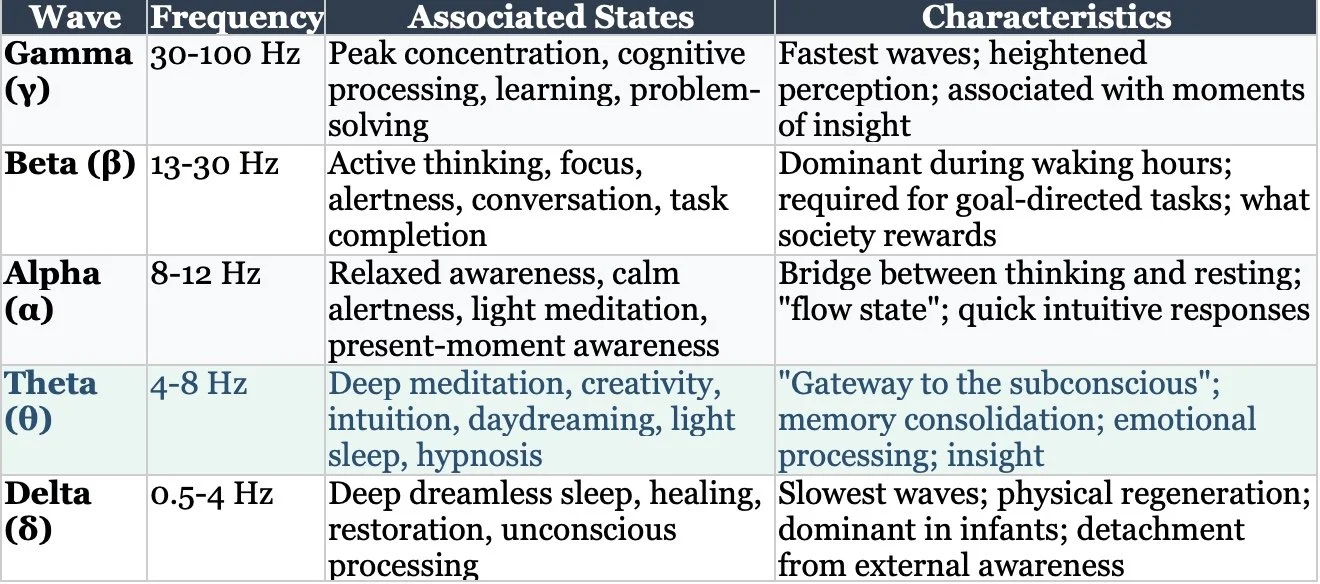
Note: Theta is highlighted because this is where ADHD brains tend to spend more time—the frequency range associated with depth, creativity, and inner access.
The Science Behind Theta Dominance in ADHD
Research confirms that the theta/beta ratio is elevated in people with ADHD. Studies using EEG technology have shown that during resting states, theta and alpha brainwaves dominate, normally shifting to beta during mental tasks requiring focused attention. For neurotypical brains, this shift happens automatically when focus is required. For ADHD brains, theta remains more active—our "default mode" doesn't fully suppress when it "should."
This is typically framed as a problem: the brain that won't turn off its internal world to focus on external tasks.
But here's what the deficit framing misses entirely: theta brainwaves are associated with deep relaxation, dreaming, meditation, and hypnosis. They're considered "the gateway to the subconscious." Theta states allow greater access to memories, intuition, creativity, and the kind of insight that emerges when we stop trying so hard.
Research on meditation practitioners shows that experienced meditators display significantly increased theta activity, particularly in frontal brain regions. This same brainwave pattern that meditators spend years cultivating? ADHD brains arrive there naturally.
Theta Waves and Intuition
Intuition is strongly linked to theta brainwave activity. This state bridges conscious and subconscious processing, making deep insights, creativity, and subconscious knowledge more accessible. Theta states occur naturally during meditation, daydreaming, and light sleep—and for those with ADHD, during much of waking life as well.
While alpha waves (relaxed awareness) facilitate quick intuitive "gut feelings," theta provides a deeper gateway to profound intuitive understanding and problem-solving by connecting us to stored memories and emotions. The theta state allows access to the subconscious mind, where pattern recognition happens below conscious awareness and emerges as "knowing" without knowing how we know.
The Default Mode Network: A Feature, Not a Bug
The neuroscience of ADHD reveals another piece of this puzzle through understanding two key brain networks:
The Default Mode Network (DMN) is a collection of brain regions (including the medial prefrontal cortex, posterior cingulate cortex, and hippocampus) that activate when we're not focused on external tasks. It's responsible for daydreaming, self-reflection, imagining the future, recalling the past, and introspection. The DMN creates your internal narrative—your sense of self and meaning.
The Task Positive Network (TPN) is the network that activates when you engage in focused, goal-directed external tasks—problem-solving, analyzing, responding to demands. It's associated with beta brainwave activity and the kind of productive attention our society rewards.
In neurotypical brains, these networks have a reciprocal relationship: when TPN turns on, DMN turns off, and vice versa. It's like a seesaw—one goes up, the other goes down.
In ADHD brains, this reciprocal relationship is disrupted—the DMN doesn't fully suppress when TPN engages—which is why your internal world keeps "intruding" during tasks. What researchers call "default mode interference" is the experience of trying to focus on a spreadsheet while your mind simultaneously processes that conversation from yesterday, wonders about dinner, and notices a pattern in the ceiling tiles.
But the DMN isn't a malfunction. It provides insight and deep introspection. It's the neural basis for self-awareness, meaning-making, and the internal narrative that shapes our sense of who we are. It's the seat of the inner world.
Reframing "Attention Deficit"
When I look at my own life through this lens, so much suddenly makes sense:
Why I love being in my inner world
My theta-dominant brain isn't failing to pay attention outward—it's naturally calibrated for attention inward. The internal landscape feels like home because my neural architecture is designed to dwell there.
Why I excel as a therapist
Therapy is fundamentally about attuning to another person's inner world while remaining connected to your own. It requires the kind of receptive, reflective attention that theta states facilitate. I'm not "working" against my brain all day—I'm working with it. The meditative quality of deep therapeutic presence aligns with my brain's natural rhythm.
Why writing from liminal states feels natural
Theta waves are linked to creative insight, the kind that emerges not through forcing but through allowing. When I write from that spacious, receptive place—not pushing for productivity but letting something come through—I'm leveraging exactly what my brain does well.
Why connecting with my inner parts feels accessible
Internal Family Systems work requires accessing internal experience with curiosity and openness. Theta states facilitate precisely this kind of inward attention. My brain's tendency to maintain access to my internal world isn't getting in the way of parts work—it's the prerequisite for it.
Why intuition comes naturally
Theta states are associated with heightened intuitive capacity. The "gut feelings" and subtle knowings that arise from deep within are subconscious processing that theta-dominant brains access more readily. When your brain naturally dwells in the frequency range that connects conscious and subconscious, intuitive information flows more freely.
Why parenting young children is so taxing for me
Here's the honest shadow side: parenting small children requires enormous amounts of beta activity. The constant task-switching, external vigilance, management of physical safety and logistics, and relentless extroverting demanded by young children runs directly counter to my brain's natural orientation. It's not a character flaw or a failure of love. It's a neurological mismatch between the demands of the role and my brain's native frequency.
Not All Neurodiversities Are the Same
It's important to note that different forms of neurodivergence have distinct brainwave signatures. They're not interchangeable, and understanding the differences helps us appreciate the specific gifts of each.
ADHD
Elevated theta, high theta/beta ratio, DMN stays active during tasks. Brain calibrated for internal, liminal, depth states.
Autism
Excessive theta AND gamma, but reduced alpha and disrupted connectivity between brain regions. Different pattern than ADHD—involves processing intensity rather than internal access.
HSP
Elevated beta and gamma, increased global brain activity. HSPs process more actively at higher frequencies—heightened information processing rather than theta-dominant depth.
Giftedness
Enhanced gamma activity, greater neural efficiency and frontoparietal synchronization. "Fast brains" that process complex information with lower energy expenditure.
The theta-dominant reframe applies specifically to ADHD—the brain calibrated for internal, liminal, depth states. Highly Sensitive Persons have a different gift: heightened processing and empathy activation at higher frequencies. Autism has yet another distinct profile involving connectivity patterns. These are different kinds of neural architecture, each with their own strengths.
A Different Ability
The neurodiversity movement asks us to consider whether neurological differences represent deficits or simply variations—different cognitive styles that may be advantageous in different contexts.
Recent research supports this reframe. Studies on ADHD and creativity consistently find that ADHD is associated with stronger divergent thinking—the ability to generate multiple ideas and make unexpected connections. The "wandering mind" isn't deficient; it's exploring. Mind-wandering itself has been linked to creative output in people with ADHD.
"Mind wandering is one of the critical resources on which the remarkable creativity of high-functioning ADHD individuals is based."
Evolutionary perspectives suggest that ADHD traits may have offered advantages throughout human history—the explorers, the innovators, the seers who perceived what others missed because their attention wasn't locked into immediate, task-focused reality. The shamans and healers who could access altered states more readily. The dreamers whose minds moved freely between worlds.
The Spiritual Dimension
From an earth-based, mystical perspective, this reframe feels even more profound. Theta states are the doorway to the liminal—the threshold space between conscious and unconscious, waking and dreaming, ordinary and sacred reality.
Indigenous cultures worldwide have honored those who move easily between worlds, whose attention flows naturally toward the unseen. The dreamers, the visionaries, the mystics, the sages, the healers, the ones with "thin veils."
What if the theta-dominant brain is simply wired for mystical perception? For receiving rather than only doing? For depth rather than only breadth?
This doesn't romanticize the very real struggles that come with ADHD in a society structured around beta-dominant productivity. The challenges are real. The accommodations we need are valid.
But it does suggest that the "deficit" label doesn’t capture the truth. We're not lacking something. We have something extra—an orientation toward inner experience that many people spend years of meditation practice trying to cultivate.
Thriving as a Theta-Dominant Being
Understanding my brain this way has shifted how I structure my life:
• I protect my reflection time—not as an indulgence, but as a necessity for a brain that processes deeply in quiet space.
• I've built work around my strengths—therapy, writing, depth work, and intuitive practice. These aren't coincidental career choices. They're expressions of a brain designed for exactly this kind of attending.
• I'm gentler about the hard parts—the struggle with logistics, the difficulty with tasks that require sustained beta attention, the exhaustion of high-stimulation environments. These make sense now. They're not failures; they're predictable mismatches.
• I honor the gift—my easy access to inner experience, my intuitive attunement, my natural comfort in liminal states. These aren't compensations for a deficit. They're the other side of the same coin.
The theta-dominant brain isn't broken. It's designed for depth. How does this show up for you?
Hi, I’m Catherine. I’m so happy to share this time and space with you.
I’m a counselor and self-trust coach living on the Emerald Coast of Florida, on the unceded land of the Muscogee. I am a creative, mystic, and neurodiverse adventurer. I love writing, creating, and connecting.
I love helping folx Befriend Your Inner Critic and Become Your Own Best Friend. I enjoy hearing from you and walking alongside you on your journey.
With a full heart,
Catherine
References & Further Reading
On Theta/Beta Ratios in ADHD
• Arns, M., Conners, C.K., & Kraemer, H.C. (2013). A decade of EEG theta/beta ratio research in ADHD: A meta-analysis. Journal of Attention Disorders.
• Wang, T.S., et al. (2023). Theta/beta ratio in EEG correlated with attentional capacity. Frontiers in Psychiatry.
On Theta Waves and Meditation
• Lagopoulos, J., et al. (2009). Increased theta and alpha EEG activity during nondirective meditation. Journal of Alternative and Complementary Medicine.
• Tang, Y.Y., et al. (2019). Frontal theta activity and white matter plasticity following mindfulness meditation. PMC.
On the Default Mode Network and ADHD
• Sonuga-Barke, E.J., & Castellanos, F.X. (2007). Spontaneous attentional fluctuations in impaired states and pathological conditions: A neurobiological hypothesis. Neuroscience & Biobehavioral Reviews.
• Castellanos, F.X., & Aoki, Y. (2016). Intrinsic functional connectivity in attention-deficit/hyperactivity disorder: A science in development. Biological Psychiatry.
On ADHD and Creativity
• White, H.A., & Shah, P. (2011). Creative style and achievement in adults with attention-deficit/hyperactivity disorder. Personality and Individual Differences.
• Hoogman, M., et al. (2022). A qualitative and quantitative study of self-reported positive characteristics of individuals with ADHD. Frontiers in Psychiatry.
• Radboud University (2025). Mind wandering links ADHD and creativity. Presented at ECNP Congress.
On Neurodiversity and Evolution
• Swanepoel, A. (2024). ADHD and ASD are normal biological variations as part of human evolution. PMC.
On HSP and Brainwave Patterns
• Neurophysiological signatures of sensory-processing sensitivity (2023). Frontiers in Neuroscience.
• Acevedo, B., et al. (2014). The highly sensitive brain: an fMRI study of sensory processing sensitivity. Brain and Behavior.